本文最后更新于 2022-05-15T17:37:15+08:00
验证上采样
理论
上采样:
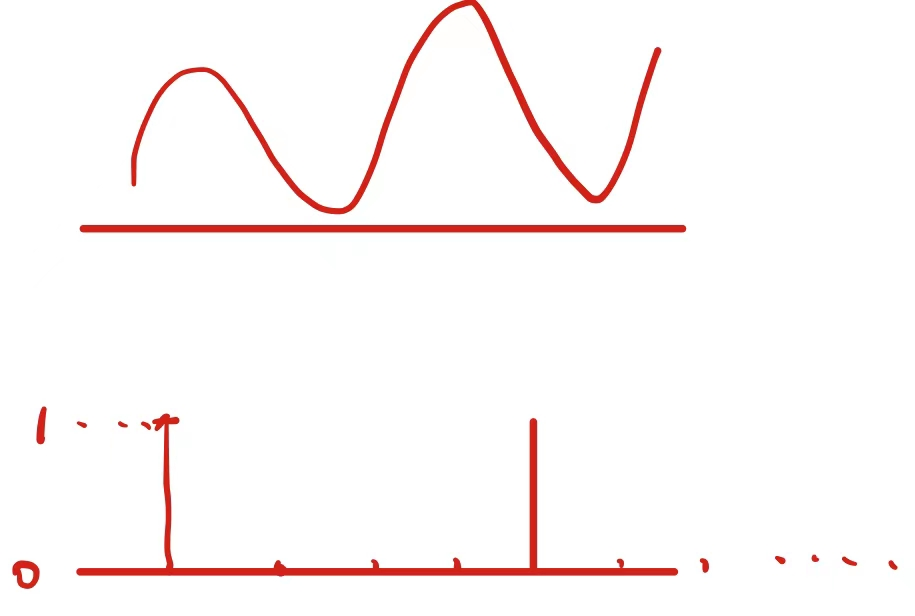
给原始\(f_s\)采样点后面补零(补up_rate-1个零)
等同于给原始信号(假设是模拟信号)乘上一个采样向量: \[
\delta = \left[1, \underbrace{0,0,\cdots}_{(\text{up-rate}-1)个\text{0}},1,\underbrace{0,0,\cdots}_{(\text{up-rate}-1)个\text{0}}\right]
\] 根据于采样定理,频谱会以\(f_s\)为周期进行搬移。
实验验证
Result


code
1
2
3
4
5
6
7
8
9
10
11
12
13
14
15
16
17
18
19
20
21
22
23
24
25
26
27
28
29
30
31
32
33
34
35
36
37
|
clc;clear;close all;
f = 1e2;
fs = 1e3;
N = 1000;
t = (0:N-1)/fs;
y = sin(2*pi*f*t+randn*2*pi);
figure(1)
subplot(211)
plot(t, y)
subplot(212)
plot((-N/2:(N-1)/2)/N*fs, fftshift(abs(fft(y))));
suptitle('原始信号')
up_rate = 10;
y_up_sample = reshape([y;zeros(up_rate-1, N)], 1, up_rate*N);
N = length(y_up_sample);
figure(2)
subplot(211)
plot( y_up_sample)
subplot(212)
plot((-N/2:(N-1)/2)/N*fs*up_rate, fftshift(abs(fft(y_up_sample))));
suptitle('10倍插值(插9个0)')
sps = up_rate;
span = 6;
h = rcosdesign(0.35, span, sps);
y_after_rcos = filter(h, 1, y_up_sample);
figure(3)
subplot(211)
plot(y_after_rcos)
subplot(212)
plot((-N/2:(N-1)/2)/N*fs*up_rate, fftshift(abs(fft(y_after_rcos))));
suptitle('成型滤波后的结果')
|