合作IRS-一个IRS拆分为两个
Cooperative Double-IRS Aided Communication: Beamforming Design and Power Scaling. Yitao Han et.al. IEEE Wireless Communications Letters, Aug. 2020 (pdf) (Citations 37)
Quick Overview
BS单天线、USER单天线 对IRS每一个element单元进行建模作者讨论了将一个拥有\(K\)个elements的IRS分解为两个分别拥有\(K_1\)和\(K_2\)(且\(K_1+K_2=K\))的IRS1和IRS2
当\(K\)足够大的时候,分割为两个IRS性能比一个IRS(有\(K\)个elements)要好。是因为其虽然受到了一共三段path-loss(BS-IRS1 IRS1-IRS2 IRS2-USER)但是其性能随\(K^4\)增长
为了简化IRS1-IRS2的channel,作者利用了IRS1-IRS2 channel 的rank-one性质,即IRS1如果对准IRS2中任意一个element,则IRS2中其他elements收到相同增益。
Main work
System model

假设上图所示的模型。则有\(\mathbf{t}\in\mathbb{C}^{K_1\times1}\),\(\mathbf{S}\in\mathbb{C}^{K_1\times K_2}\),\(\mathbf{r}^T\in\mathbb{C}^{1\times K_2}\),两个IRS的反射系数为\(\Phi_1\)和\(\Phi_2\),则信道为: \[ h=\mathbf{r}^T\Phi_2\mathbf{S}\Phi_1\mathbf{t} \]
作者引入了三维坐标系,对每个IRS element进行位置建模
将上述三个信道建模为LoS,有:
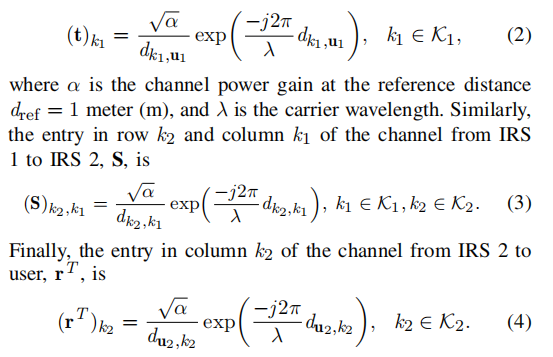
然后利用\(\mathbf{S}\)的Rank-one性质,简化\(\mathbf{S}\)为:

这意味着只要知道位置信息,就可以对IRS1-IRS2的channel进行建模
Design of Joint Passive Beamforming
取\(\Phi_1\)的元素\(\phi_{1,k_1}\)为:
\[
\phi_{1, k_{1}}=\left(\frac{\left(\mathbf{g}_{1}\right)_{k_{1}}(\mathbf{t})_{k_{1}}}{\left|(\mathbf{t})_{k_{1}}\right|}\right)^{*}, \quad k_{1} \in \mathcal{K}_{1}
\] 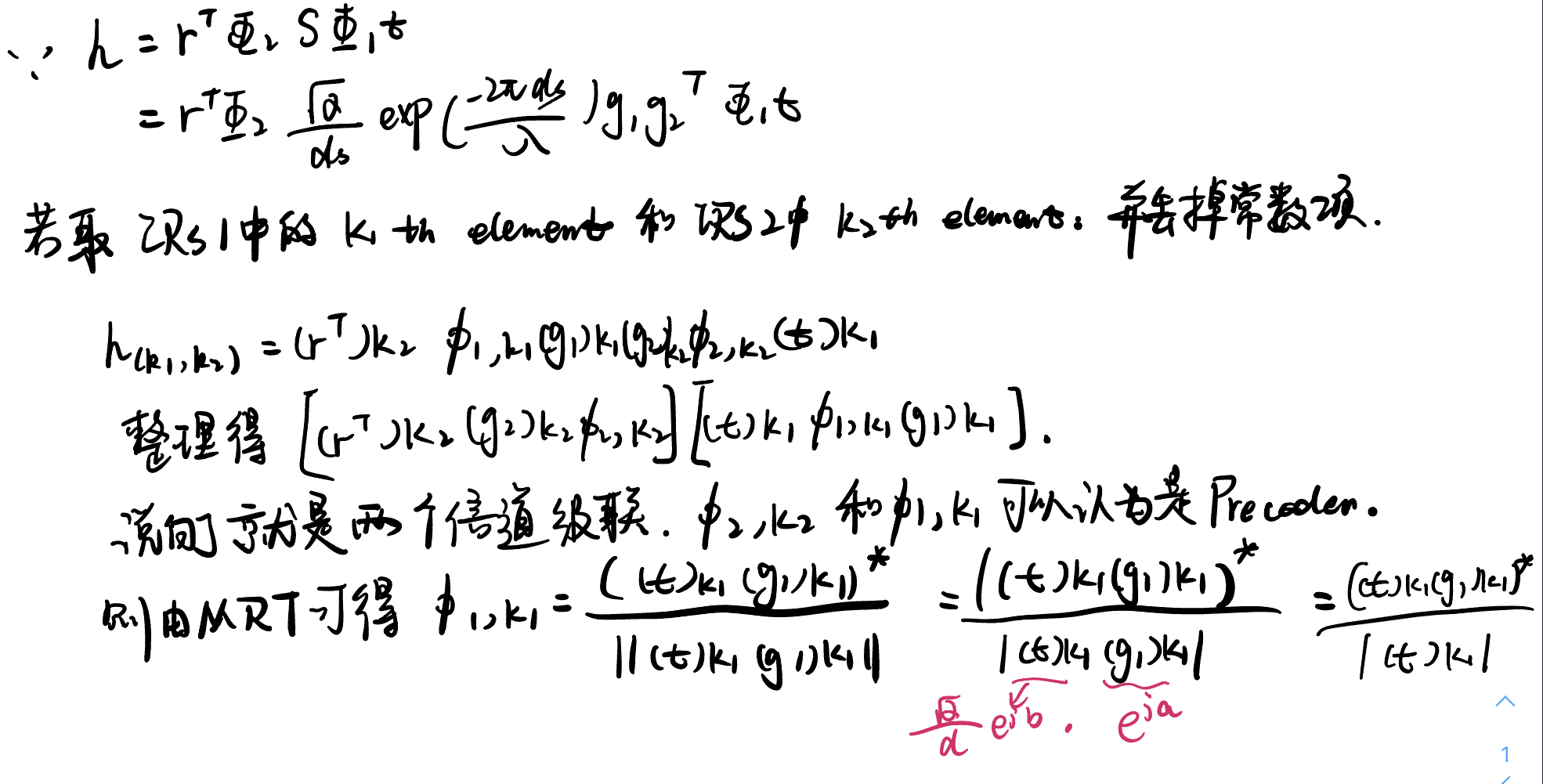
对于\(\Phi_2\)中的元素\(\phi_{2,k_2}\)同理。
此时的接收端: \[
|h|^{2}=\left|\mathbf{r}^{T} \mathbf{\Phi}_{2} \mathbf{S} \boldsymbol{\Phi}_{1} \mathbf{t}\right|^{2} \approx \frac{\alpha^{3}}{\left(d_{\mathbf{r}} d_{\mathbf{S}} d_{\mathbf{t}}\right)^{2}}\left(K_{1} K_{2}\right)^{2}
\] 
Simulation
我只仿真了2.2节中推导的近似表达式的结果,因为实际的结果需要对每个IRS element建模,有点复杂,而且不知道作者怎么将IRS elements进行排布的。所以这里就没有仿真。
1 | |
需要用到一个function:
1 | |
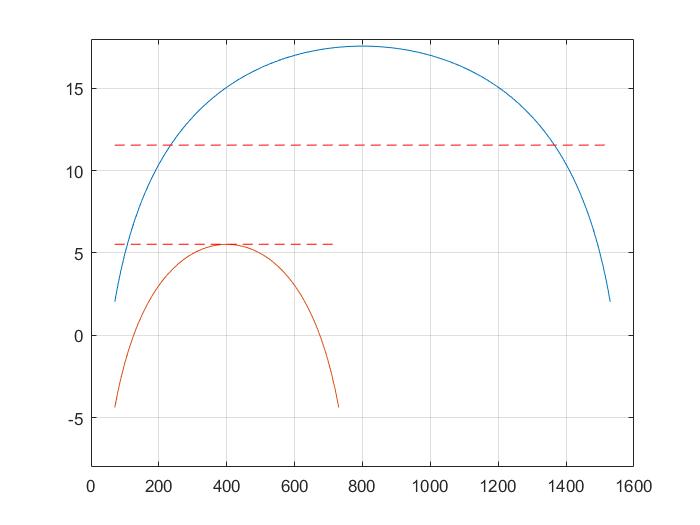
结果和作者文中的结果有一定的出入,但是在相对的增益上是相同的:
- 800 elements 和1600 elements 的benchmark case之间差约6dB
- 800 elements 和1600 elements 的two IRS cooperation case之间差约12dB
说明仿真问题应该是在某些稀疏上进行了整体的缩放。
Question
- 作者提出这个模型,前提条件是inner IRS信道是rank-one的。这个rank-one到底决定了\(\textbf{S}\)推导的哪一步?
if IRS 1 beams towards one element on IRS 2, the rest elements on IRS 2 can enjoy the same power gain
- 这种对每一个element建模的方法是否是主流?有没有必要?